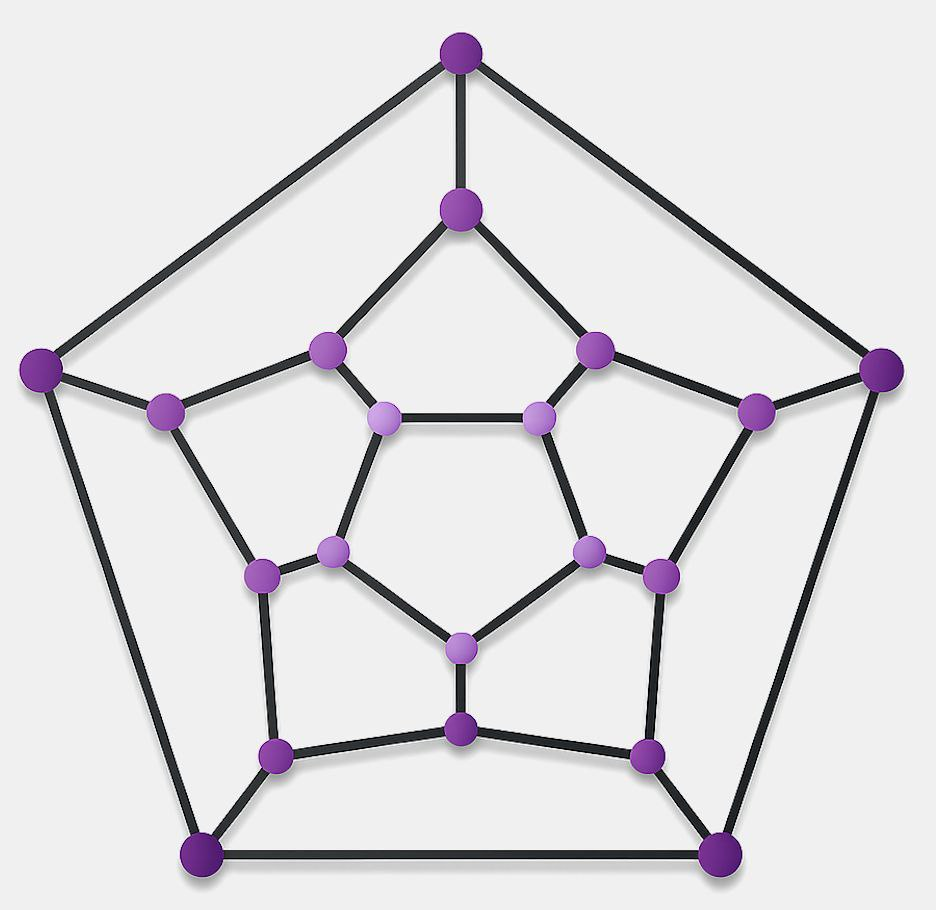
Euler's Formula for Planar Graphs
Euler’s Formula for Planar Graphs
Theorem
For any connected planar graph drawn without edge intersections:
$$V - E + F = 2$$where $V$ is the number of vertices, $E$ the number of edges, and $F$ the number of faces (including the outer face).
Proof Sketch
The proof proceeds by induction on the number of edges. For a tree ($F=1$), we have $E = V-1$, so $V - (V-1) + 1 = 2$. Adding an edge while maintaining planarity increases both $E$ and $F$ by 1, preserving the equality.
Applications
- Proves that $K_5$ and $K_{3,3}$ are non-planar
- Yields the inequality $E \le 3V - 6$ for $V \ge 3$
- Foundation for the Four Color Theorem
Historical Context
Discovered by Leonhard Euler in 1752 while studying polyhedra, this formula marked the birth of topological graph theory.